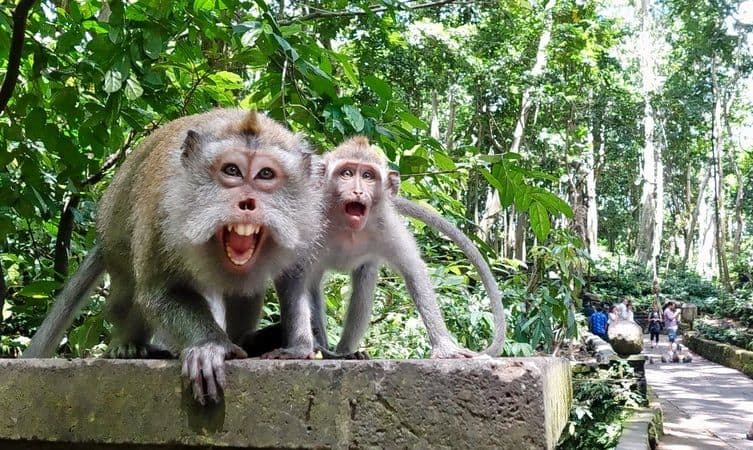
The Sacred Monkey Forest Sanctuary — known locally as Mandala Suci Wenara Wana — is a 12.5-hectare protected forest in the village of Padangtegal, at the southern edge of Ubud. It is one of the most visited attractions in Bali, drawing well over 100,000 visitors a month in high season, and it is easy to see why: paved trails wind between banyan roots and nutmeg trees, three temples dating back to the 14th century sit hidden in the greenery, and more than 1,200 Balinese long-tailed macaques go about their day around you.
Unlike a zoo, the Monkey Forest is a living example of the Balinese Hindu philosophy of Tri Hita Karana — harmony between people, nature, and the spiritual world. The forest is owned and managed by the Padangtegal village community, and ticket revenue funds conservation, temple upkeep, and village programs. The macaques here are wild animals living in their natural habitat; they are fed by sanctuary staff but roam, forage, squabble, and raise their young exactly as they would anywhere else in Bali's forests.
What to See Inside the Monkey Forest
Most visitors come for the monkeys, and the sanctuary delivers. The population is divided into several troops, each holding its own territory — around the main temple, the central meeting point, the eastern forest, and the cremation ground. Watch for mothers carrying infants, juveniles chasing each other across the canopy walkways, and dominant males keeping order at the feeding stations. Staff feed the troops sweet potato, banana, corn, and papaya leaf three times daily, which is why the macaques here are healthier and calmer than the ones you may meet at roadside temples elsewhere in Bali.
The forest is also a significant archaeological and religious site. Three temples stand within its boundaries, all built around 1350 during the Pejeng dynasty:
- Pura Dalem Agung Padangtegal — the main death temple, dedicated to Hyang Widhi in the personification of Shiva. Its entrance, framed by moss-covered guardian statues, is the most photographed spot in the sanctuary.
- Pura Beji (Holy Spring Temple) — a bathing and purification temple in a ravine on the western side, reached by a dragon-flanked stone bridge over the river.
- Pura Prajapati — the funerary temple beside the village cemetery, used for cremation ceremonies.
The temples remain active places of worship, so entry is reserved for those praying — but the carved gates, banyan-shrouded courtyards, and Komodo dragon stairways can all be admired from the paths. Beyond the temples, don't miss the giant banyan tree near the central point, the river ravine walkway, and the Rudraksha grove of sacred beading trees.
Ticket Prices & Opening Hours
The sanctuary is open every day from 09:00 to 18:00, with ticket sales closing around 17:30. Entry costs approximately IDR 80,000 for adults and IDR 60,000 for children (3–12) on weekdays, rising to about IDR 100,000 and IDR 80,000 on weekends and Indonesian public holidays. Tickets can be bought at either entrance gate or online through the official site, and there is no time limit once inside. Parking is available at the main entrance on Jalan Monkey Forest.
Staying Safe Around the Macaques
The macaques are habituated to people but they are still wild animals, and most incidents involve visitors ignoring a few simple rules. Follow these and your visit will be trouble-free:
- Do not bring food, drinks, or plastic bags into the forest — macaques recognise them instantly.
- Secure loose items: sunglasses, hats, phones, water bottles, and dangling jewellery are the most commonly stolen objects.
- Never touch, grab, or pick up a monkey, and never touch a baby macaque — mothers defend infants aggressively.
- Avoid prolonged direct eye contact and don't smile with your teeth showing; both read as threats.
- If a monkey climbs on you, stay calm, don't scream, and walk slowly — staff with slingshots and food will redirect it.
- Keep to the paved paths; they cover the whole sanctuary and protect the forest floor.
How to Get There & When to Visit
The sanctuary sits at the end of Jalan Monkey Forest, a 15-minute walk south of Ubud Palace and the art market — if you are staying in central Ubud you don't need transport at all. From southern Bali (Kuta, Seminyak, Canggu, Nusa Dua) allow 60–90 minutes by car depending on traffic; a private driver for the day is the easiest option and lets you combine the forest with the Tegalalang Rice Terrace and the Goa Gajah Elephant Cave, both under 20 minutes away.
Arrive between 09:00 and 10:30 for the calmest experience — feeding time keeps the troops busy, tour buses haven't arrived, and the morning light filtering through the canopy is ideal for photos. Late afternoon after 16:00 is the second-best window. Midday during July–August peak season is when the paths are most crowded. The forest is walkable year-round, though paths can be slippery after rain in the November–March wet season.
Combine It With Nearby Ubud Attractions
The Monkey Forest anchors almost every Ubud itinerary. Within a short drive you can add the Tegalalang Rice Terrace (20 min north), the Bali Swing, the ancient Goa Gajah sanctuary, and the Museum Puri Lukisan in central Ubud. Travelling with children who want closer animal encounters? Bali Zoo and the Elephant Safari Park in nearby Gianyar offer keeper-led experiences, or browse every option on our Bali attractions hub. For a stress-free day covering all of it, see our guided Ubud tours.